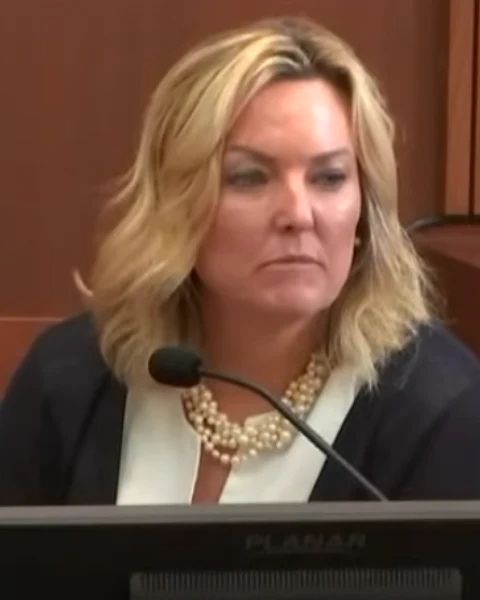
Dawn Hughes
Forensic psychologist with a Ph.D., specializing in interpersonal violence and traumatic stress. Maintains a clinical and forensic practice in New York and has presented widely on IPV in legal settings. Retained by Heard's legal team to conduct a forensic psychological evaluation and offer expert opinion testimony on intimate partner violence dynamics and trauma.
Testimony Impact
Hughes testified across two phases of the trial — first on Days 13-14 in Heard's case-in-chief, then on Day 23 in rebuttal to Dr. Shannon Curry. She told the jury her roughly 29-hour evaluation, supported by twelve psychological tests, supported two opinions: that Heard's reported abuse is consistent with IPV and that Heard suffers PTSD caused by Depp's conduct. She walked through specific incidents Heard reported, framed them through trauma-bonding and reactive-violence theory, and rebutted Curry's malingering finding by attacking Curry's psychometric interpretations. On cross, Dennison played audio of Heard admitting to hitting Depp and starting fights, and documented protocol deviations across the CAPS-5, CTS-2, PCL-5, and Danger Assessment.
Notable Quotes From The Record
“intimate partner violence is a pattern of manipulation, fear, and coercive control that happens within an intimate relationship”
Hughes's foundational definition of IPV, establishing the conceptual framework she applies to the Depp-Heard relationship throughout her testimony.
“when you pair sort of this violent dynamic, physical violence, sexual violence, with love and attachment, it creates a trauma bond.”
Explains the psychological mechanism—trauma bonding—that Hughes uses to account for why Heard remained in the relationship despite reported abuse.
“Ms. Heard's report of intimate partner violence, and the records that I reviewed, is consistent with what we know in the field about intimate partner violence, characterized by physical violence, psychological aggression, sexual violence, coercive control, and surveillance behaviors.”
Hughes's primary expert opinion, the central conclusion her entire direct examination builds toward and the foundation for Heard's defense.
“that is a very inaccurate way to describe that scale and that test.”
Hughes's direct rebuttal of Dr. Curry's malingering characterization, framing Curry's ATR interpretation as a methodological error rather than a legitimate finding.
“And this is the one thing that women are always afraid of, that no one's going to believe them.”
Hughes explains why the Waldman statement calling Heard's sexual violence a hoax was the most psychologically damaging—it activated a fear universal among sexual violence survivors.
“I'm being paid $500 an hour.”
Established Hughes's financial interest in the case after her deposition had incorrectly reflected $100/hour, supporting Dennison's bias challenge.
“Yes, it says "hasta la muerte," until death.”
Hughes confirmed the inscription on the knife Heard gifted Depp, allowing Dennison to juxtapose a lethality-risk framework with Heard's choice of that phrase for a gift to the alleged abuser.
“The phraseology is that Mr. Depp told her the only way out of this relationship is death.”
Hughes provides Heard's reported context for the knife's inscription, grounding it in a documented therapist record rather than an affectionate gesture.
“I don't have any changes to my opinions that I gave yesterday.”
Hughes's closing affirmation that cross-examination did not undermine her core conclusions on IPV and PTSD.
“That score, the one that's elevated, that she's talking about that percentile rank, has a raw score. Amber's raw score is a 10, the cutoff score is a 15. She's nowhere near that level of exaggerated symptoms where I can't further look at that test.”
Directly refutes Curry's 98th-percentile claim on the TSI-2 by citing the instrument's own manual and raw score threshold, framing Curry as unqualified to interpret the test.
“Dr. Curry did not independently administer -- measure malingering, and there are other ones that she could have done to augment her evaluation.”
Turns a methodology critique back on Curry by pointing out Curry administered no independent malingering measure of her own.
“On this measure, Amber Heard scored in a moderate range. She did not overexaggerate on this test. She could have said no, mild, moderate, severe, and extreme. All of hers were either 2s, or 1s, or 0s.”
Rebuts the claim that Heard's CAPS-5 results reflected extreme or fabricated symptom endorsement, instead characterizing them as clinically moderate.
“I vehemently disagree with that. As I stated to you, over 29 hours and 12 psychological tests and reviewing a slew of documents in this case, most importantly, therapy records and interview, collateral interviews with therapists, using all that data, that is what a solid forensic methodological exam looks like.”
Hughes's most emphatic defense of her evaluation, countering Curry's suggestion that her opinions were opinion-based rather than methodologically grounded.
“It does say that, yes.”
Hughes concedes the PCL-5 manual itself states the instrument should not be used as a standalone diagnostic tool, directly supporting Dennison's attack on her pre-CAPS-5 diagnosis.
“I made my diagnosis during clinical interviewing and 11 other psychological tests that supported diagnosis of PTSD and symptomatology consistent with PTSD.”
Hughes's primary defense of diagnosing before the CAPS-5: that clinical interviewing and multiple tests together were sufficient.
“And I oriented her to not limit herself to the last year, to get an accurate assessment of the violence and abuse that she experienced in the relationship.”
Hughes's explanation for deviating from the CTS-2 one-year timeframe, subsequently struck by the court on Dennison's objection.
“We talked about this before, Mr. Dennison, I had 88 pages of notes of what happened. It would have been redundant to put it there.”
Hughes's defense for leaving CAPS-5 frequency blanks empty, citing extensive supplemental notes as a substitute for standardized field completion.
“the more successive traumas that you have, the greater likelihood that somebody is going to have psychological consequences and symptomatology as a result”
Hughes frames cumulative IPV exposure as clinically meaningful, justifying her decision to assess trauma across the full length of the Depp-Heard relationship rather than a fixed window.
“In the 88 pages were many of the documented incidents of intimate partner violence.”
Hughes characterizes her supplemental notes as a substantive clinical record of IPV incidents, directly countering the cross-examination implication that blank test fields indicated methodological gaps.
“when they're used in research, that means the document stands alone”
Hughes articulates the core distinction Bredehoft sought to establish: blank CAPS-5 fields are a research-scoring concern, not a flaw in a clinical evaluation supported by extensive narrative notes.
Key Moments
Hughes delivers an extended educational framework on IPV — coercive control, the cycle of violence, trauma bonding — before pivoting to her case-specific opinions that Heard's reported abuse is consistent with established IPV patterns and that Heard suffers PTSD caused by Depp.
Day 13 · Direct of Dawn Hughes
Hughes describes her ~29-hour forensic evaluation across four in-person New York sessions and two Zoom sessions, supported by twelve psychological tests and a review of collateral records, and rebuts Dr. Curry's ATR-scale malingering characterization as a misreading of the instrument.
Day 13 · Direct of Dawn Hughes
Dennison plays audio of Heard saying 'I did start physical fights' and 'I was hitting you'; Hughes concedes that if Heard struck first, the conduct would not fit her reactive-violence framing, and ultimately acknowledges Depp suffered both physical and psychological violence.
Day 14 · Cross of Dawn Hughes
Dennison challenges Hughes's CAPS-5 administration — blank anchoring narrative, blank frequency fields, side-margin notations for childhood trauma — and her exclusive use of female pronouns for IPV victims, painting her as a biased professional witness.
Day 14 · Cross of Dawn Hughes
Bredehoft plays additional segments of the June 2016 audio in which Depp calls the relationship 'a fucking crime scene waiting to happen' and counts 'three physical fights in the last month and a half,' rehabilitating Hughes's mutual-violence and IPV-cycle framing.
Day 14 · Redirect of Dawn Hughes
In rebuttal, Hughes systematically attacks Curry's psychometric interpretations test by test, asserting Curry misread the TSI-2 manual and is 'not qualified to interpret it,' and rejecting Curry's claim that Heard scored in the most extreme categories.
Day 23 · Direct of Dawn Hughes
Dennison cross-examines Hughes using each test's own admitted manual to document protocol deviations: PTSD diagnosed before the CAPS-5 was administered, the CTS-2 'past year' window re-oriented, the Danger Assessment calendar skipped, and CAPS-5 frequency fields left blank.
Day 23 · Cross of Dawn Hughes
On brief redirect, Hughes draws the clinical-vs-research distinction — blank CAPS-5 frequency fields matter when a test stands alone in research, but not in a clinical evaluation supported by her 88 pages of notes — before being excused.
Day 23 · Redirect of Dawn Hughes
Locations
Evidence From Their Proceedings (29)
Bonnie Jacobs Therapy Notes (Heard, from October 2011)
Treatment notes of psychologist Dr. Bonnie Jacobs documenting Heard's sessions over approximately five years beginning October 2011, including Heard's reports of physical and…
Catalog entry →CAPS-5 — Hughes Administration (Heard, Dec. 27, 2021)
The CAPS-5 structured clinical interview was administered by Hughes to Heard on December 27, 2021, producing an approximately 59-page handwritten scoring form. The plaintiff…
Catalog entry →Depp–Heard Multi-Segment Argument Recording (PX 343)
Extended audio recording played in multiple proceedings across several segments, covering discussions of the Australia fight, bathroom retreat disputes, and Heard's…
Catalog entry →TSI-2 — Hughes Administration (Heard)
The TSI-2, a clinical instrument assessing trauma-related symptoms including an Atypical Response Scale measuring exaggeration, was administered by Hughes to Heard. The plaintiff…
Catalog entry →Hasta la muerte bowie knife gifted by Amber Heard
A large bowie knife inscribed "Hasta la muerte / XX Slim" (until death), given by Amber Heard to Johnny Depp as a gift, variously dated to circa 2012 (during The Lone Ranger…
Catalog entry →PAI — Hughes Administration (Heard)
The PAI, a broadband personality inventory with built-in validity scales, was administered by Hughes to Heard. The plaintiff introduced critical item endorsements as Plaintiff's…
Catalog entry →Plaintiff's Ex. 144 — ER Photo, Depp's Severed Fingertip (Australia)
Graphic emergency room photograph of Johnny Depp's severed right middle finger sustained during the Australia incident. The photograph provides a clear profile of the injured…
Catalog entry →Connell Cowan Treatment Records (Defendant's Ex. 1057)
Clinical treatment notes and deposition of Dr. Connell Cowan, who treated Heard for approximately two years; reviewed by both Shannon Curry and Dawn Hughes as part of their expert…
Catalog entry →Danger Assessment Scale — Hughes Administration (Heard)
The Danger Assessment Scale, a validated instrument identifying risk factors for serious or lethal domestic violence, was administered by Hughes to Heard.
Catalog entry →Depp–Falati Text Messages, Oct 31, 2015
Text messages between Johnny Depp and Erin Falati dated October 31, 2015, produced from Depp's own records, in which Depp references the Australia finger injury with the phrase…
Catalog entry →Hughes Expert Witness Training Presentation — National Clearinghouse
A PowerPoint presentation titled 'Expert Witness Testimony in Cases Involving Domestic Violence,' given by Hughes and Mary Ann Dutton to the National Clearinghouse for the Defense…
Catalog entry →Hughes IPV Expert Witness Presentation — Kings County Bar Assoc.
A PowerPoint presentation titled 'The Use of Psychological Experts in Cases of Domestic Violence,' given by Hughes to the Kings County Bar Association, covering myths and…
Catalog entry →PCL-5 — Hughes Administration (Heard)
The PCL-5, a face-value self-report checklist of DSM-5 PTSD symptoms, was administered by Hughes to Heard as part of her evaluation protocol.
Catalog entry →Plaintiff's Ex. 145 — ER Photo, Cigarette Burn on Depp's Cheek (Australia)
Emergency room photograph showing a cigarette burn wound on Johnny Depp's cheek, taken during the Australia incident. The photograph is among the images associated with Depp's…
Catalog entry →Audio recordings, text messages, emails, and kitchen video reviewed as part of e
Audio recordings, text messages, emails, and kitchen video reviewed as part of evaluation
Catalog entry →CTS-2 Instructions with Dennison Annotations (Demonstrative)
The published CTS-2 instructions bearing Dennison's redline annotations, introduced as Plaintiff's 1309 as a demonstrative exhibit.
Catalog entry →Danger Assessment Scale — Blank Test Form (Demonstrative)
A blank Danger Assessment Scale test form, published as a demonstrative exhibit and introduced as Plaintiff's 1310.
Catalog entry →Dawn Hughes 88-Page Supplemental Clinical Notes
Hughes's 88-page supplemental clinical notes prepared in connection with her evaluation of Heard.
Catalog entry →Dawn Hughes Curriculum Vitae
The curriculum vitae of Dawn Hughes, Ph.D., submitted as Defendant's 1434.
Catalog entry →Dawn Hughes Deposition (March 28, 2022)
The pre-trial deposition of Dawn Hughes taken March 28, 2022.
Catalog entry →Depp to Kipper — March 19, 2015 Finger Injury Email
Email from Depp to Dr. David Kipper, dated March 19, 2015, in which Depp states 'I've chopped off my left middle finger,' introduced in redacted form as Defendant's Exhibit 398.
Catalog entry →Hughes 12-Instrument Psychological Testing Battery (Heard)
Hughes administered a battery of 12 psychological instruments to Heard: the PAI, TSI-2, M-FAST, PCL-5, CAPS-5, Beck Depression Inventory, Beck Anxiety Inventory, Mood Disorders…
Catalog entry →Hughes Comprehensive Therapy Records Review
Set of therapy records reviewed by Dr. Dawn Hughes encompassing records of Dr. Bonnie Jacobs (2011–2014), Dr. Connell Cowan (2014–2015), Dr. Laurel Anderson, and Dr. Amy Banks,…
Catalog entry →Hughes Intake Background Information Sheet (Plaintiff's 938)
A background information sheet from Hughes's evaluation of Heard, previously admitted into evidence as Plaintiff's 938.
Catalog entry →Hughes Intake Background Questionnaire (Plaintiff's 1246)
The background information questionnaire completed by Hughes during her initial intake evaluation of Amber Heard, including sections on intimate relationships noting James Franco…
Catalog entry →M-FAST — Hughes Administration (Heard)
The M-FAST, a forensic assessment instrument designed to detect feigned psychiatric symptoms, was administered by Hughes to Heard as the sole malingering measure in her evaluation.
Catalog entry →PCL-5 Instruction Manual (National Center for PTSD)
The official PCL-5 instruction manual published by the National Center for PTSD, introduced as Plaintiff's 1312.
Catalog entry →Testimony and Depositions Reviewed by Hughes
Deposition and trial testimony of Heard and Depp from both U.S. and UK proceedings, plus depositions of therapists Bonnie Jacobs, Connell Cowan, and Amy Banks, reviewed by Dr.…
Catalog entry →Three Waldman Statements April–June 2020 (Hughes Basis)
The three public statements issued by Adam Waldman on April 8, April 27, and June 24, 2020, considered together as a set during Dawn Hughes's expert testimony.
Catalog entry →