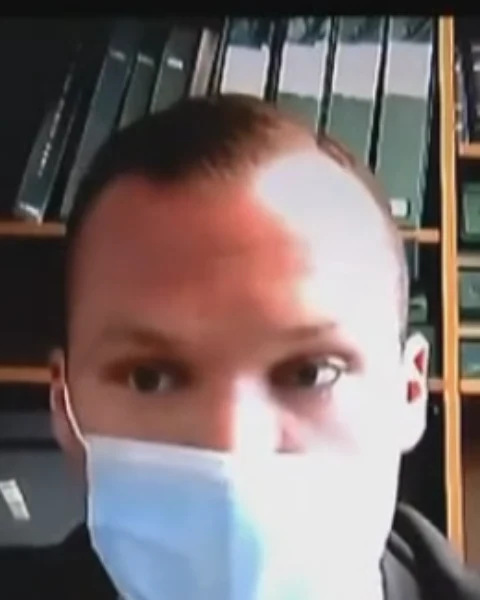
Tyler Hadden
Tyler Hadden was a probationary LAPD patrol officer with one to three weeks of on-the-job experience at the time of the May 21, 2016 incident. He responded alongside his training officer, Melissa Saenz, to a domestic disturbance call at the Eastern Columbia Building. Depp's legal team called him to establish the factual record of what officers observed and concluded that night.
Testimony Impact
Hadden testified that he and Officer Saenz arrived at 8:57 p.m., logged the incident as a verbal dispute, and closed the call at 9:22 p.m. with a business card rather than a report. He saw no visible injuries on Heard, no property damage in the penthouse, and noted only redness he attributed to crying. On cross, Chew established that Hadden wore corrective contacts and had a clear view of Heard at roughly ten feet on two occasions, directly countering any claim that limited sight conditions explained his no-injury finding. On redirect, Bredehoft used LAPD domestic violence policy exhibits to expose that officers took no photographs, failed to interview all witnesses present, and never asked why Heard was crying — arguing the verbal-dispute classification reflected a self-limiting investigation rather than an affirmative finding.
Notable Quotes From The Record
“Because the victim didn't request a report, and during our investigation, it didn't reveal that we needed to take a report.”
Hadden's stated rationale for not filing an official report — no evidence of crime and no victim request — which Bredehoft challenges through the photo exhibits.
“After discussing the investigation with my partner at the scene, the - Ms. Heard refused any medical treatment and had no visible injuries. There was no sign of struggle. And the victim - correction, the witness that was there, that I spoke with, was uncooperative as well.”
Hadden's summary of why the incident was classified as a verbal dispute — the core factual basis for not writing a report.
“No, I was never this close to be able to examine her face.”
Hadden concedes he could not assess facial injuries from the distance he maintained, a key limitation Bredehoft uses to argue his conclusions are unreliable.
“Knowing what our investigation revealed, no. That pink's consistent with crying.”
Hadden interprets Heard's pink cheeks and eyes in a photo as consistent with crying rather than injury, framing his perception as colored by the verbal-dispute conclusion already reached.
“No. I wear contacts, though, so I can see perfectly fine.”
Directly addresses any suggestion that uncorrected vision limited Hadden's ability to observe Heard's face and potential injuries.
“Just the redness, which was consistent with her crying.”
The only physical observation Hadden made on Heard's face—attributing it to crying rather than trauma, central to Depp's denial of visible injury.
“I attempted to gather information of who the husband was and what occurred and where he possibly went, so we could interview kind of all the different parties, and he wouldn't give me his name of who the husband was.”
Establishes Drew's active uncooperativeness, undermining any claim that officers failed to conduct a thorough investigation.
“Yes. Because that's how the call was broadcasted and created.”
Clarifies that the 'victim' label in dispatch records is administrative terminology, not a finding of criminal conduct—addressing a potential inference drawn from direct examination.
“I don't know. That's a great question. I don't know why she was crying.”
Hadden's inability to explain Heard's emotional state underscores the limited inquiry conducted at the scene.
“all of these things would have been documented if there was a report.”
Hadden attributes the absence of documentation to Heard's refusal to file, implicitly shifting responsibility to her.
“Dispute, a verbal dispute. It's not against the law to argue. I argue with my wife.”
Hadden's characterization and personal analogy illustrate how quickly the scene was assessed and closed.
Key Moments
Bredehoft establishes Hadden had been a probationary officer for only one to three weeks with no prior law enforcement experience, laying the foundation for her challenge to the adequacy of his observations and conclusions.
Day 10 · Direct of Tyler Hadden
Hadden concedes he was never physically close enough to examine Heard's face, acknowledging a core limitation that Bredehoft uses to undercut the weight of his no-injury finding.
Day 10 · Direct of Tyler Hadden
Hadden explains his rationale for classifying the call as a verbal dispute and issuing a business card: Heard refused medical treatment, showed no visible injuries, there was no property damage, and she characterized the incident as verbal only.
Day 10 · Direct of Tyler Hadden
Chew establishes that Hadden wore corrective contacts and had an unobstructed view of Heard at approximately ten feet on two separate occasions — directly neutralizing any suggestion that poor vision limited his ability to observe injuries.
Day 10 · Cross of Tyler Hadden
Hadden's protective sweep of the penthouse found no broken glass, no spilled wine, and no signs of property damage or disturbance of any kind, corroborating Depp's account of the night.
Day 10 · Cross of Tyler Hadden
Chew identifies the uncooperative male from direct examination as Josh Drew, who refused to give Depp's name and declined to report any domestic violence, establishing that investigative limitations were not solely attributable to officer conduct.
Day 10 · Cross of Tyler Hadden
Bredehoft walks through LAPD DV policy exhibits and Hadden concedes that neither officer took photographs, the woman embracing Heard on the couch was never interviewed, and he never asked Heard why she was crying — exposing systematic gaps in the investigation.
Day 10 · Redirect of Tyler Hadden
Locations
Evidence From Their Proceedings (8)
CAD Summary / Incident Recall — May 21, 2016 Penthouse Call
The Computer-Aided Dispatch (CAD) summary and incident recall for the May 21, 2016 call to 849 S. Broadway, coded 242D (battery/DV), recording the call timeline (initiation 8:35…
Catalog entry →LAPD Domestic Violence Supplemental Report Form (Form 15.40.02)
The LAPD Domestic Violence Supplemental Report form containing victim observation checklists, victim emotional state assessments, crime scene indicators, and approximately 70…
Catalog entry →May 21, 2016 Face Photos — Exhibits 24–29 Series
Multiple photographs of Heard's face from May 21, 2016 showing facial redness, including two photos sharing an identical timestamp of 9:25:12 PM but differing in brightness and…
Catalog entry →LAPD Chief of Police Memo — DV Supplemental Report Form Revision (Nov. 24, 2014)
A November 24, 2014 memo from the Office of the Chief of Police announcing the revision of the LAPD Domestic Violence Supplemental Report Form to provide a more concise picture of…
Catalog entry →Hallway Carpet Stain Photo — Exhibit 18
A photograph of the carpeting or flooring in the hallway area near the penthouse elevator, showing a reddish stain or discoloration. The same image was introduced during the…
Catalog entry →LAPD Business Card Left for Heard — May 21, 2016
The front and back of the LAPD business card left for Amber Heard on the night of May 21, 2016, bearing handwritten notes including 'refused report' and 'advised can call at later…
Catalog entry →LAPD DV Field Notebook Divider — Case Preparation Guidelines (LAPD 18.30.02)
An LAPD field notebook divider (LAPD 18.30.02, dated January 31, 2010) setting out domestic violence laws and case preparation guidelines, including obligations to note…
Catalog entry →Document Referenced re Hadden's Verbal-Dispute Classification (Exhibit 11, Hadden Deposition)
A document introduced by defense counsel during Hadden's deposition testimony when asking what Hadden determined the call to be. The specific content of the document was not…
Catalog entry →