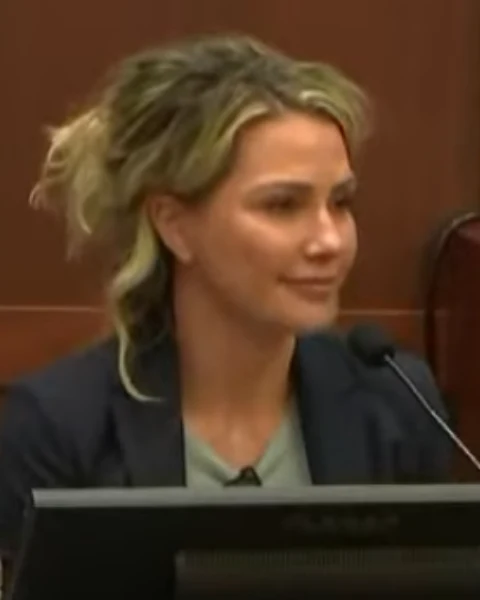
Shannon Curry
Forensic psychologist with a Psy.D. and a California-based practice (Curry Psychology Group). Licensed roughly ten years at the time of trial, not board certified. Retained by Depp's legal team in January 2021 to conduct a direct psychological evaluation of Amber Heard, administering the MMPI-2 and CAPS-5 across two sessions in December 2021 and reviewing extensive treatment and case records.
Testimony Impact
Curry testified twice, first in Depp's case-in-chief and again as a rebuttal witness after Dawn Hughes. She diagnosed Heard with borderline and histrionic personality disorders, found no PTSD, and characterized Heard's conduct — including her 2016 restraining order — as consistent with BPD rather than trauma. On rebuttal, she attacked Hughes's choice of clinical checklists, CAPS-5 administration, and omission of response-distortion data, citing a 98th-percentile TSI-2 atypical score. On cross, Bredehoft surfaced an undisclosed pre-retention dinner at Depp's home and deposition answers limiting Curry's IPV and bipolar expertise.
Notable Quotes From The Record
“The results of Ms. Heard's evaluation supported two diagnoses: Borderline personality disorder and histrionic personality disorder.”
The core conclusion of the examination, establishing the diagnostic finding Depp's team would build the remainder of Curry's testimony around.
“people with borderline personality disorder, it seems to be a predictive factor for women who implement violence against their partner, and one of the most common tactics that they'll use is actually physically assaulting and then getting harmed themselves”
Directly supported Depp's narrative that Heard was the physical aggressor by linking BPD to a pattern of initiating violence and then sustaining injury.
“Ms. Heard did not have PTSD. And there were also pretty significant indications that she was grossly exaggerating symptoms of PTSD when asked about them.”
The headline finding on PTSD: not only did Heard fail to meet criteria, but Curry affirmatively characterized her responses as gross exaggeration — directly attacking the credibility of Heard's abuse claims.
“she initially said, "Yes, I have that," to 19 of the 20 symptoms. That's not typical even of somebody with the most disabling form of PTSD.”
Specific quantitative basis for the exaggeration finding, giving the jury a concrete and memorable benchmark.
“I was interviewed at Mr. Depp's home by his legal team Dinner was served.”
Curry's own framing of the pre-retention meeting — correcting Bredehoft's characterization as a social dinner — while conceding the basic facts of the gathering.
“I can't speak to whether or not there's a coincidence. What I can tell you is, my opinions are based on the results of my evaluation.”
Curry deflects Bredehoft's suggestion that her BPD diagnosis aligned suspiciously with Depp's prior accusations about Heard, anchoring her defense to methodology.
“I did not disclose that. It's not significant to the report.”
Curry admits she never disclosed the pre-retention dinner with Depp in her expert report, while maintaining her view that the omission was immaterial.
“The MMPI-2 profile, it's specific to how she approached this test, and you're correct, for this test, it was a defensive profile, not an exaggerated profile.”
Curry concedes the MMPI-2 showed a minimizing rather than exaggerating response style, directly qualifying the symptom-exaggeration narrative from direct examination.
“I prefer feigning, which you brought up earlier, because it indicates someone is intentionally exaggerating but I don't know, necessarily, why.”
Curry reframes the cross-examination's malingering challenge by distinguishing intent-neutral feigning, preserving her exaggeration finding without overclaiming motive.
“Ms. Heard was in the 98th profile - 98th percentile, meaning that she is - she - she had engaged in extreme levels of exaggeration.”
Curry uses Hughes's own objective test against Heard's PTSD claim, noting the 98th-percentile result on the intentional exaggeration scale.
“you're going to have an automatic bias for your client. It's almost a sense of protection, advocacy, wanting their best”
Curry explains why treating providers' accounts carry less evidentiary weight than a forensic evaluation — the advocacy role is structural, not a character flaw.
“given that PTSD is the most frequently feigned and claimed diagnosis. In civil courts, if you are handing somebody a checklist that has every single symptom of PTSD, you're essentially teaching them all the little nuances that we're looking for to get that diagnosis”
Explains why the PCL-5 is inappropriate in forensic civil litigation — it functions as a symptom guide for examinees motivated to obtain a PTSD finding.
“our cookbook actually states that that 3-6 profile, specifically, tends to be associated with cruel and ruthless behavior, particularly to those who they perceive as less powerful to them and subordinates”
The MMPI-2 3-6 code type finding is Curry's primary personality-pathology conclusion about Heard and directly supports Depp's narrative of the relationship dynamic.
“Scored more of those unusual items that are not consistent with PTSD than 98 percent of people who had ever taken the test.”
Quantifies Heard's TSI-2 exaggeration finding, the same 98th-percentile figure Curry first raised in redirect on Day 9.
“There was no evidence of PTSD.”
Curry's dispositive conclusion, delivered as a standalone sentence after enumerating her multi-method evaluation — the central rebuttal to Hughes's diagnosis.
“J would say that it can't be triggered if PTSD isn't present.”
Closing answer that forecloses the counterclaim theory that Waldman's public statements caused Heard psychological harm, within the scope permitted by the court's sidebar ruling.
“I did not disclose that I was interviewed because that's standard procedure.”
Curry's justification for not disclosing the pre-retention meeting — her framing of the dinner as a routine interview — is the central defense against Bredehoft's conflict-of-interest attack.
“I never had a client that was essentially homebound because of their celebrity status.”
Curry explains why the interview took place at Depp's home rather than in her office — an explanation Bredehoft does not challenge, but which implicitly acknowledges the unusual circumstances of the engagement.
“Not for a forensic evaluation of this sophisticated examinee.”
Curry's rebuttal to Bredehoft's assertion that the SCID is the gold standard for personality disorder assessment — she draws a line between clinical and forensic contexts that runs through her entire methodology.
“the majority of those were checklists, which are inappropriate in the forensic setting”
Curry's consistent position on Hughes's 12 instruments — framing them as symptom checklists rather than validated forensic measures — is the methodological core of her rebuttal testimony.
“It's a structured clinical interview. It's for rendering a diagnosis. It's best for treatment because you're asking direct questions of the examinee and about symptoms. So if you have an examinee who has a tendency to minimize, you're not going to get much information.”
Curry signals the SCID's inherent limitation with uncooperative or minimizing examinees, implicitly framing the decision not to use it as methodologically sound.
“Because, well, first of all, I had a limited amount of time for my evaluation, and I already had to use — just to complete the interview was extremely time consuming, and I had to even restructure it into handouts so that I could keep Ms. Heard on track.”
Curry attributes the omission of the SCID to both time pressure and Heard's difficulty engaging with direct questioning, rehabilitating her methodology against cross-examination criticism.
Key Moments
Curry delivers her core diagnostic opinion — borderline and histrionic personality disorders, no PTSD — and walks the jury through the MMPI-2's validity scales and Heard's 3-6 code type, framing Heard's behavior as image-conscious, externalizing, and prone to cruelty toward less powerful individuals.
Day 9 · Direct of Shannon Curry
Curry explains how people with BPD may weaponize restraining orders or abuse claims as 'administrative violence' to prevent abandonment, offering the jury an alternate frame for Heard's 2016 TRO without directly opining on the underlying events.
Day 9 · Direct of Shannon Curry
Bredehoft establishes that Curry attended a 3–4 hour dinner at Depp's home with Depp, Waldman, Chew, and Vasquez before retention and never disclosed it in her report; Curry concedes the omission but insists it was immaterial.
Day 9 · Cross of Shannon Curry
Using Curry's own deposition, Bredehoft pins her to a prior 'No' on ever testifying as an IPV expert and secures her admission that the MMPI-2 profile was defensive/minimizing rather than exaggerated.
Day 9 · Cross of Shannon Curry
On redirect, Curry pivots to the CAPS-5 and to Hughes's own objective test, telling the jury Heard scored in the 98th percentile for intentional exaggeration — using the opposing expert's instrument against Heard's PTSD claim.
Day 9 · Redirect of Shannon Curry
As rebuttal witness, Curry lays out a three-category framework accusing Hughes of misrepresenting her own tests, misrepresenting Curry's testing, and presenting Heard's self-reports as expert fact, then methodically critiques Hughes's eight checklists as unsuited for forensic use.
Day 22 · Direct of Shannon Curry
Curry quantifies the TSI-2 atypical response finding — Heard endorsed more unusual, non-PTSD items than 98 percent of all test-takers — and concludes flatly: 'There was no evidence of PTSD.'
Day 22 · Direct of Shannon Curry
Bredehoft contrasts Curry's credentials with Hughes's (board certification, IPV specialization, longer evaluation) and confirms no treating provider — Jacobs, Cowan, or Anderson — ever diagnosed Heard with BPD or HPD.
Day 22 · Cross of Shannon Curry
Locations
Evidence From Their Proceedings (21)
Kitchen Cabinet Video — Depp, February 10, 2016
A video filmed by Heard on February 10, 2016, showing Johnny Depp slamming kitchen cabinets, pouring wine, and smashing glasses while yelling. The version TMZ received via a…
Catalog entry →Bonnie Jacobs Therapy Notes (Heard, from October 2011)
Treatment notes of psychologist Dr. Bonnie Jacobs documenting Heard's sessions over approximately five years beginning October 2011, including Heard's reports of physical and…
Catalog entry →CAPS-5 — Hughes Administration (Heard, Dec. 27, 2021)
The CAPS-5 structured clinical interview was administered by Hughes to Heard on December 27, 2021, producing an approximately 59-page handwritten scoring form. The plaintiff…
Catalog entry →TSI-2 — Hughes Administration (Heard)
The TSI-2, a clinical instrument assessing trauma-related symptoms including an Atypical Response Scale measuring exaggeration, was administered by Hughes to Heard. The plaintiff…
Catalog entry →Falati Nursing Notes for Amber Heard (Aug 2014–May 2016)
Erin Falati (née Boerum), Heard's personal nurse, maintained clinical notes documenting Heard's physical condition, emotional state, and medication regimen from August 2014…
Catalog entry →PAI — Hughes Administration (Heard)
The PAI, a broadband personality inventory with built-in validity scales, was administered by Hughes to Heard. The plaintiff introduced critical item endorsements as Plaintiff's…
Catalog entry →Connell Cowan Treatment Records (Defendant's Ex. 1057)
Clinical treatment notes and deposition of Dr. Connell Cowan, who treated Heard for approximately two years; reviewed by both Shannon Curry and Dawn Hughes as part of their expert…
Catalog entry →CAPS-5 — Curry Administration (Heard)
The CAPS-5, a structured clinical interview for PTSD developed by the National Center for PTSD and the VA, was administered by Curry to Heard.
Catalog entry →Danger Assessment Scale — Hughes Administration (Heard)
The Danger Assessment Scale, a validated instrument identifying risk factors for serious or lethal domestic violence, was administered by Hughes to Heard.
Catalog entry →February 2021 Expert Witness Designation for Shannon Curry
A February 2021 expert witness designation signed by Depp's counsel listing three opinions attributed to Curry before she had evaluated Heard or formed any views, introduced as…
Catalog entry →MMPI-2 — Curry Administration (Heard)
The MMPI-2, a 567-item objective personality and psychopathology inventory, was administered by Curry to Heard on an iPad. Curry produced a 25-page scoring outline summarizing the…
Catalog entry →PCL-5 — Hughes Administration (Heard)
The PCL-5, a face-value self-report checklist of DSM-5 PTSD symptoms, was administered by Hughes to Heard as part of her evaluation protocol.
Catalog entry →Shannon Curry Deposition (March 21, 2022)
The pre-trial deposition of Shannon Curry taken March 21, 2022, including pages 199, 200, 207–208, 240, 254–255, 270, 305–306, and 337.
Catalog entry →Abusive Behaviors Observation Checklist — Hughes Administration (Heard)
The Abusive Behaviors Observation Checklist, a brief therapeutic checklist with no published validation research, was administered by Hughes to Heard.
Catalog entry →Banks and Anderson Clinical Notes — Curry Record Review
Dr. Amy Banks's notes and transcript together with Dr. Laurel Anderson's clinical notes as couples therapist, reviewed by Shannon Curry.
Catalog entry →CTS-2 — Hughes Administration (Heard)
The Conflict Tactic Scale 2 (Revised, 2nd edition), a research instrument developed for studying family violence prevalence in anonymous survey populations, was administered by…
Catalog entry →Depp 'Borderline Personality Disorder' Phrase Recording (Curry Testimony)
Audio recording, without a specified exhibit number, in which Depp uses the phrase 'borderline personality disorder' in reference to Heard; played during Shannon Curry's testimony.
Catalog entry →Hughes Forensic Evaluation Report and Interview Notes (Heard)
Dr. Dawn Hughes's forensic psychological evaluation report and interview notes of Amber Heard, including a recorded disclosure of Heard's self-reported arm-cutting at intake.
Catalog entry →Kipper and Banks Medical Records — Curry Record Review
Dr. David Kipper's medical records for Amber Heard, together with records from Dr. Amy Banks, reviewed by Dr. Shannon Curry as part of her comprehensive pre-evaluation case record…
Catalog entry →Raquel Pennington's deposition testimony and/or declaration.
Raquel Pennington's deposition testimony and/or declaration.
Catalog entry →Shannon Curry Day 10 Trial Testimony (Page 2710, Line 13)
A specific passage from Shannon Curry's Day 10 trial testimony at page 2710, line 13, containing a prior sworn statement confirming she had not been asked to testify about Heard's…
Catalog entry →